Describe the stain, smell or leak through Call Now and an independent provider serving the San Antonio area will answer.
Tools used in a moisture inspection
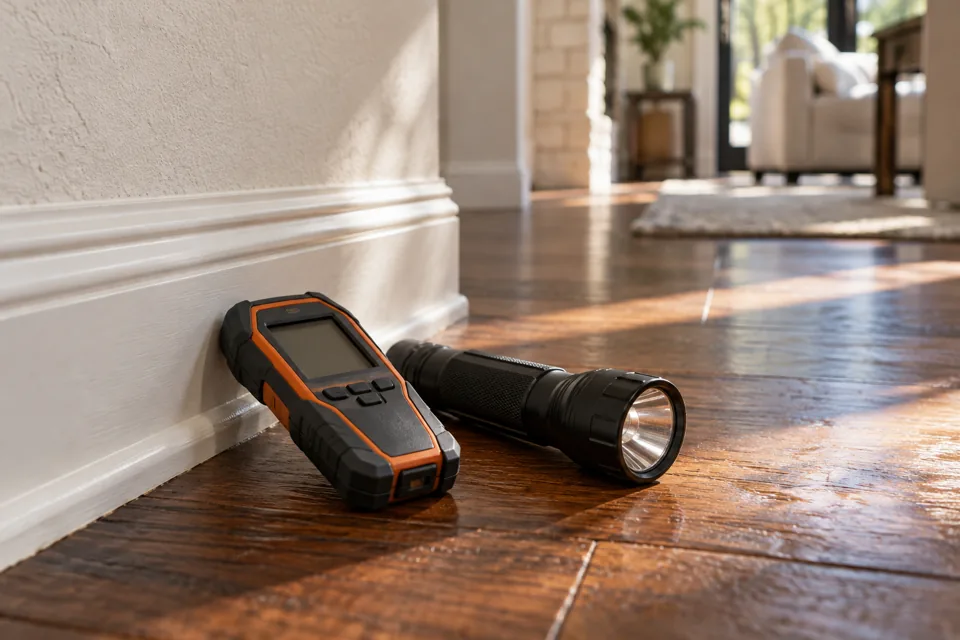
| Tool | What it shows | Limits |
|---|---|---|
| Hygrometer | Relative humidity and dew point of the air | Shows conditions in the room, not in the wall |
| Borescope | A view inside a wall cavity through a small hole | Shows only what the camera can reach |
| Pinless moisture meter | Moisture below a surface without damaging it | Reads a limited depth |
| Pin moisture meter | Moisture content inside wood and drywall | Needs contact and small holes |
| Thermal imaging camera | Temperature patterns that suggest wet areas | Does not measure moisture directly |
| Acoustic and pressure tests | Locate plumbing leaks in lines and slabs | Performed by leak-detection specialists |
Where hidden moisture comes from
- Condensation from AC lines, drain pans and cold ducts
- Supply and drain line leaks in walls and under floors
- Poor grading and gutters that push water to the foundation
- Roof, window and siding leaks that run down wall cavities
- Slab leaks under concrete floors
What the report should include
- Readings with locations and photos
- The probable source of the moisture and how it was found
- A recommendation: monitor, dry, remove materials or repair the source
- A note about mold risk and whether remediation or sampling may be needed
Moisture mapping
The inspector takes readings throughout the affected area and plots wet, borderline and dry zones on a map. A baseline for comparison during drying comes from photos paired with readings, and the map reveals whether the moisture is spreading or shrinking.
Questions to ask a restoration company
- What water category and loss class do you assess, and why?
- How many air movers and dehumidifiers will be used, and how will you show the readings?
- Is repair included, or only mitigation, and who does the rebuild?
- What will you remove and what will you dry in place?
- What is your dry standard, and who confirms it?
How moisture inspection works from the first call to dry standard
Moisture sets the pace in restoration, and the first hours decide how much material can be saved. That is why the work runs in a fixed order, with every step documented.
- Safety first: stop the water, turn off power to wet areas and check for structural, electrical and slip hazards.
- Assessment: identify the source, the water category and the class of the loss, and map moisture with meters and thermal imaging.
- Extraction: remove standing water with pumps and extractors before anything else.
- Removal: take out materials that cannot be dried or are contaminated, such as wet carpet pad, insulation and drywall below the water line.
- Drying: place air movers and dehumidifiers and check moisture readings daily until the materials meet the dry standard.
- Cleaning and sanitizing: treat affected surfaces and contents, and deodorize if needed.
- Documentation and next steps: a record of readings and photos for the insurer, then repairs once everything is dry.
Safety, contamination and the standards
For water damage restoration, the industry reference is the IICRC S500 standard, setting out water categories, loss classes and drying goals. A clean supply-line leak turns more contaminated as time passes, and sewage or flood water counts as contaminated from the start.
Do not touch electrical equipment while standing in water, and do not use household vacuums on water. If there is sewage, a gas smell or structural movement, leave and call for help. Wear gloves and boots in affected areas and keep children and pets out.
Mistakes that make water damage worse
- Drying with household fans only. Without dehumidification the moisture just moves into the air and other materials.
- Throwing out evidence before the insurer sees it. Photograph first.
- Treating sewage or flood water as clean water.
- Waiting. Materials that stay wet for more than a day or two risk mold and permanent damage.
- Covering wet materials with paint, flooring or baseboard before they are dry.
What to do before the crew arrives in San Antonio
- Take photos and videos of the damage and the source before you move anything
- Turn off electricity to wet areas at the breaker only if you can reach the panel without standing in water
- Move valuables, papers and electronics to a dry place
- Open windows for air if the weather is dry, but do not run fans on contaminated water
- Stop the source if you can do so safely, and shut off the main water supply if a pipe has failed
What shapes the written scope
No two losses are the same. A written scope should say what was found and which of these factors applied, so that estimates can be compared fairly.
- The class of the loss, which depends on how much material is wet and how fast it will dry
- The source of the water and how long materials stayed wet
- The water category: clean, gray or contaminated
- Access, the number of rooms and levels, and any contents that need to be moved or cleaned
- Whether mitigation only or repairs and rebuild are included
Restoration terms explained
- IICRC S500: the industry standard for water damage restoration
- Flood cut: cutting drywall a set height above the water line to remove wet material
- Reconstruction: the repairs that rebuild finishes after mitigation
- Dry standard: the moisture reading that matches comparable dry materials
- LGR dehumidifier: a low-grain refrigerant dehumidifier used in most drying jobs
- Mitigation: actions that stop damage from growing, such as extraction and drying
- Air mover: a high-velocity fan used to move air across wet surfaces
What makes moisture inspection different in San Antonio
San Antonio is a large Texas city with limestone soils, many slab foundations and a climate of hot summers and sudden heavy storms. Flash floods can follow intense rain on the Edwards Plateau and fill low-lying streets and homes quickly.
Hailstorms damage roofs, and the resulting leaks wet attics and ceilings. Slab leaks, water heater failures and AC condensate drains are common causes of interior water damage in homes. Ask the provider how these local conditions change how fast materials dry and what you should expect at your address.
Moisture inspection across San Antonio and nearby cities
The area covered by Damage Restoration San Antonio is San Antonio, Texas and its surroundings, among them Alamo Heights, Schertz, New Braunfels, Boerne and Helotes. Each call and request is confirmed by address.
At the top of the page, Call Now lets you say what happened and when. An independent restoration company then confirms your address, assesses the damage and puts the scope in writing.
Related help in San Antonio
If this is not quite your situation, these pages cover the neighboring questions: Signs and inspection: damage restoration; Water damage restoration; Fire damage restoration; Structural drying and dehumidification. The service area list shows every nearby city and ZIP code covered.